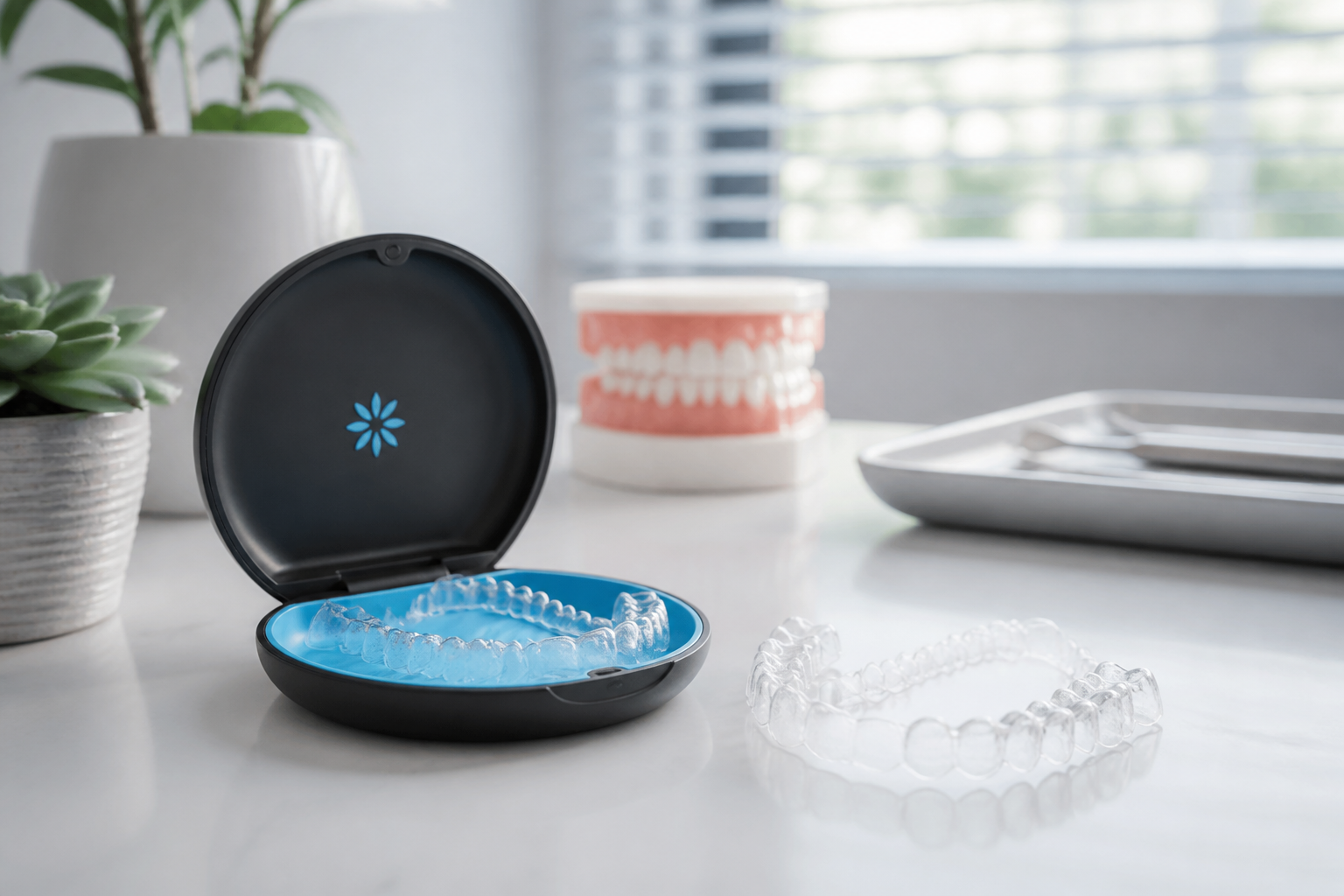
Spark™ Clear Aligners and Teen Compliance: An Honest Look at Who They Work Best For
You’ve done the research. You know clear aligners can straighten teeth without metal brackets, without the dietary restrictions, and with a level of discretion most teenagers genuinely appreciate. But somewhere in your reading, you hit the number that gives every parent pause: 22 hours a day. That’s how long aligners need to stay in the mouth to work. And if your teenager is the kind of kid who loses their retainer, leaves their water bottle at school, or needs three reminders to do homework, the question of clear aligner compliance starts to feel a lot more urgent than the question of which treatment path is right for them.
This article is for parents who want a clear-eyed framework, not a sales pitch. At SmileHaus Orthodontics, located at 1414 Fair Oaks Avenue, Unit 7, Dr. Karla Thompson’s approach to teen consultations reflects exactly that: treatment planning that starts with the patient in front of her, not the treatment she wants to sell.
Why Compliance Is the Real Variable in Clear Aligner Treatment
Before comparing brands or asking about cost, it helps to understand why wear time is so consequential. Clear aligners work by applying continuous, calibrated pressure to teeth over a sustained period. Each tray is designed to move teeth a precise amount before the next tray takes over. When a teen wears aligners for 18 hours instead of 22, that pressure is interrupted. Teeth drift back slightly during the hours the trays are out. Over weeks, those small interruptions compound. The result is that teeth don’t track as planned, which can mean refinements, additional trays, and extended treatment time.
For parents who want to understand how clear aligners work from a mechanical standpoint, that foundational context is useful before any consultation — particularly because the aligner itself is not the variable. The patient’s daily behavior is. That distinction is what makes evaluating teen aligner candidacy more nuanced than evaluating an adult’s.
What Compliance Failure Actually Looks Like
Parents sometimes picture compliance failure as dramatic: a teenager hiding aligners in their locker or refusing to put them in at all. In practice, it’s usually subtler. It looks like taking trays out at lunch and forgetting to put them back in for two hours. It looks like removing them for a sports practice and leaving them on the bathroom counter overnight. It looks like wearing the same tray an extra week because the next set “feels tight” and the teen doesn’t want to deal with it.
None of these behaviors are malicious. They’re developmentally normal. Adolescents are still building the executive function that makes self-monitoring consistent behavior automatic. Some teenagers have that capacity well ahead of schedule. Others develop it later. Neither says anything about a teen’s character or intelligence. It’s simply a variable that matters clinically.
When non-compliance becomes a pattern, the practical consequences can include needing to order refinement trays to correct tracking issues, extended overall treatment duration, and the possibility that some movements planned in the original case design don’t fully resolve without additional intervention. These aren’t catastrophic outcomes, but they can add cost and time that parents understandably want to avoid.
How Dr. Thompson Evaluates Teen Readiness, Not Just Case Complexity
Most orthodontic consultations center on clinical complexity: how far the teeth need to move, whether there are skeletal issues, what the bite looks like. Dr. Thompson evaluates all of that. But for teenagers, the consultation at 1414 Fair Oaks Avenue, Unit 7 includes a layer of conversation that goes beyond the x-rays.
She looks at questions like: Is this teenager motivated by the treatment, or is the parent driving the decision? How does the teen handle other responsibilities that require daily consistency? Does the family have the bandwidth to provide external reminders and accountability, at least in the early months? Is the teen involved in activities, like contact sports or frequent social events, where removing and reinserting aligners repeatedly will create friction?
These aren’t questions with right or wrong answers. They’re inputs into a clinical recommendation. A teenager who wants straighter teeth, understands why compliance matters, and has a parent willing to check in regularly is a strong aligner candidate regardless of age. A teenager who is indifferent about the treatment, or who struggles with other self-managed routines, may get a better clinical outcome with a fixed appliance.
To understand what that initial appointment involves, your first orthodontist appointment at SmileHaus is designed to give families that fuller picture without pressure.
Spark™ Clear Aligners for Teens: What Sets Them Apart in This Category
Spark™ Clear Aligners, made by Ormco, are the primary aligner system Dr. Thompson uses at SmileHaus — chosen for cases where a patient’s clinical profile and readiness make removable treatment a strong fit. For parents comparing aligner options, a few things are worth knowing.
Spark™ trays are made from TruGEN material, which is noted for clarity and stain resistance relative to other aligner materials. For teenagers who drink coffee, tea, or colored beverages (and many do), this is a practical consideration. Trays that discolor quickly become visually obvious, which can reduce a teen’s motivation to wear them consistently.
Spark™ Clear Aligners for teen cases also include compliance indicators — small blue dots on the trays that fade with wear time. These aren’t foolproof, but they give parents and the clinical team a rough proxy for whether the trays are being worn. When an indicator hasn’t faded appropriately by the follow-up visit, that’s a conversation starter before the issue compounds.
Spark™ cases for teens also typically include replacement trays for a certain number of sets, acknowledging that teenagers lose things. That’s a practical design decision, not a gimmick. Lost trays that go unreplaced for days or weeks can contribute to the same tracking problems as non-wear, so having replacements available without extra cost matters.
What Spark™ Clear Aligners do not do is remove the compliance requirement. No clear aligner system can. That’s the honest limitation of the category.
When Pitts21 PRO Braces Are the Better Clinical Choice
For teenagers who are not strong aligner candidates, traditional braces are not a consolation prize. At SmileHaus, Pitts21 PRO braces are the fixed-appliance option, and they’re worth understanding on their own terms.
Pitts21 PRO uses a self-ligating bracket system, meaning there are no elastic ties holding the wire. Self-ligating brackets use a built-in clip mechanism instead, which reduces friction and supports more efficient tooth movement over the course of treatment. Families considering orthodontics for teens often ask whether braces today are meaningfully different from what they remember. The Pitts21 system is a reasonable answer to that question.
The compliance dynamic with braces is fundamentally different. The brackets are bonded to the teeth. They work continuously, around the clock, without any action required from the patient between appointments. A teenager who forgets to put trays back in after lunch has no equivalent failure mode with braces. The treatment happens whether or not the teen is thinking about it.
This is not to say braces are easier in every respect. There are dietary adjustments, daily hygiene habits matter more, and the aesthetic trade-off is real. But for a specific subset of teens — particularly those whose case complexity, behavior patterns, or family situation make aligner compliance genuinely uncertain — Pitts21 PRO braces may deliver a more predictable clinical result.
The comparison between braces and aligners for a specific teenager is exactly the kind of question worth exploring in a consultation at 1414 Fair Oaks Avenue, Unit 7, where the recommendation will be based on the individual patient rather than a default preference.
Making the Decision: A Framework for Parents
If you leave this article with one practical takeaway, let it be this: the right treatment for your teenager is not the one that sounds best in a brochure. It’s the one that matches your teen’s current readiness, your family’s capacity to support the process, and the clinical specifics of the case.
Here are the questions worth sitting with before a consultation:
- Does my teenager want this treatment, or am I the one who wants it for them?
- Can they realistically maintain a new daily habit with moderate, not constant, reminders?
- Do they participate in activities where removing and reinserting trays will happen multiple times daily?
- How would we handle it if compliance became a problem three months in?
None of these questions disqualify a teenager from aligners. But they shape how Dr. Thompson frames the recommendation, and how families can set realistic expectations going in. For a broader look at how braces and aligner decisions are made, the clinical principles apply regardless of age.
Start With an Honest Conversation
The goal at SmileHaus Orthodontics, at 1414 Fair Oaks Avenue, Unit 7 in South Pasadena, is not to put every teenager in aligners or to steer every family toward braces. It’s to make a recommendation that a family can understand, act on, and feel confident about. That starts with a conversation that takes the whole patient into account.
If you’re weighing Spark™ Clear Aligners against Pitts21 PRO braces for your teenager — and want a professional opinion grounded in both clinical assessment and honest compliance expectations — schedule your free consultation with Dr. Thompson at SmileHaus Orthodontics today. Come with your questions. Bring your teenager if they’re ready. Leave with a clearer picture of what the right path forward looks like for your family.