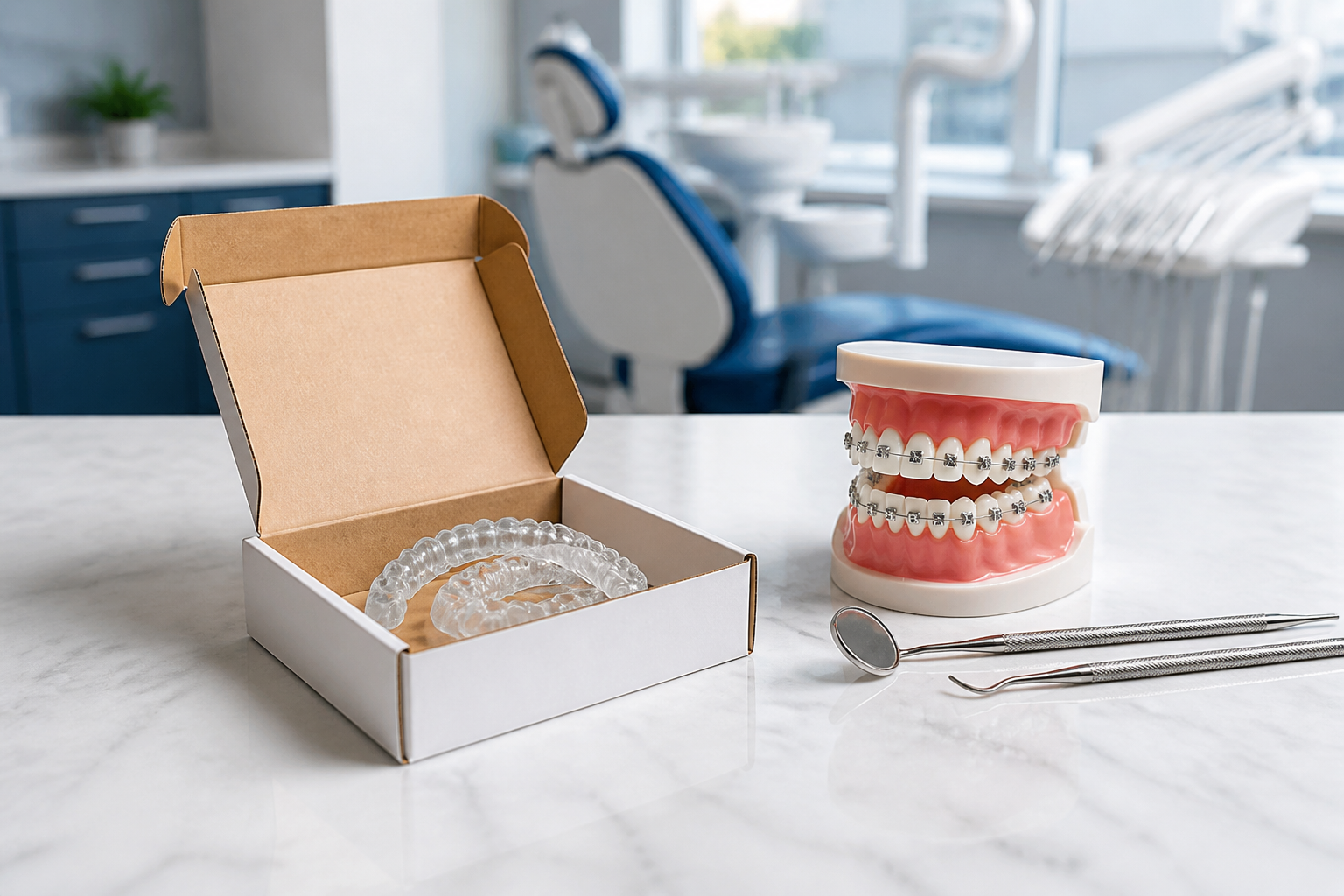
Mail-Order Aligners vs. Braces: What Patients Are Learning the Hard Way
You have probably seen the ads. A bright smile fills your screen, a price tag appears that is hundreds of dollars less than what you remember your last orthodontist quoting, and a kit arrives at your door a few days after you mail in some impressions. The pitch is simple: skip the office visits, skip the overhead, get straighter teeth for less. For families managing tight budgets or adults weighing the mail order aligners vs braces question on their own, that pitch can feel genuinely compelling.
Then the complications start.
This article is not a sales pitch. It is an honest look at what the clinical literature, regulatory agencies, and patients who have been through both experiences are reporting. If you are weighing a direct-to-consumer aligner kit against supervised orthodontic treatment, you deserve a clear accounting of what each path actually costs, not just what it costs up front.
The Real Lifecycle Cost of “Affordable” Mail-Order Aligners
The advertised price of most direct-to-consumer aligner companies falls somewhere between $1,500 and $2,500. Compared to a full course of supervised orthodontic treatment, that number looks attractive. What it does not show is the full picture.
Direct-to-consumer companies do not take X-rays before treatment begins. They cannot assess root angles, bone density, or the position of teeth that have not yet fully erupted. They issue aligner trays based on surface impressions or scans, which capture the visible crowns of teeth but tell a clinician nothing about what is happening at or below the gumline.
When treatment goes wrong, and published case reports document that it does, patients typically discover the problem only after it has progressed. Corrections to relapsed or worsened alignment, treatment for root resorption (shortening of tooth roots that may result from excessive or misdirected force), periodontal intervention for gum recession that can be associated with unsupervised tooth movement: these costs are not small, and they are not covered by the company that sold you the kit. Some patients who have pursued this route have reported significant out-of-pocket costs for corrective treatment; individual experiences vary, and no general cost comparison can be guaranteed.
That is the cost illusion the direct-to-consumer model depends on. The upfront number is real. The total number, once you factor in what can go wrong, often is not a bargain at all.
What Clinical Supervision Actually Does
When you come into a supervised orthodontic practice like SmileHaus Orthodontics at 1414 Fair Oaks Avenue, Unit 7, your treatment begins before a single wire is placed or a single aligner tray is made. It begins with a comprehensive clinical examination, including diagnostic X-rays, photographs, and in some cases 3D imaging. That examination exists for a specific reason: to make sure tooth movement is safe for your specific anatomy.
Every mouth is different. Teeth that look crowded at the surface may have roots that are angled toward each other in ways that change which movements are appropriate. Some patients have bone loss that needs to be stabilized before orthodontic forces are applied. Some have habits, like grinding or jaw positioning issues, that would undermine certain treatment approaches. A clinician who examines you in person and reviews your full records before treatment starts can identify all of this. An impression kit mailed to your house cannot.
Ongoing supervision matters just as much as the initial exam. During treatment, teeth move through living bone. That process needs to be monitored. If something is not progressing as expected, a supervising orthodontist can identify it at a regular appointment and adjust the plan before it becomes a problem. Regular check-ins are not administrative overhead. They are built-in safety checkpoints.
If you are curious about what to expect at your first visit with an orthodontist, the process is more straightforward than many people expect, and it gives you a much clearer picture of your actual options before any commitment is made.
At-Home Aligner Risks the Ads Do Not Mention
The risks of unsupervised tooth movement are documented, not theoretical. The American Association of Orthodontists has raised concerns about direct-to-consumer aligner models, and case studies published in peer-reviewed journals describe patients experiencing root resorption, worsened bite relationships, gum recession, and relapse requiring retreatment.
Some of the most common at-home aligner risks include:
Root resorption. Excessive or misdirected force on a tooth can shorten its roots. This is not always visible or painful during treatment. By the time it is discovered on an X-ray, the damage is done and is generally irreversible.
Bite changes. Aligners that move anterior (front) teeth without accounting for posterior (back) bite stability can open or shift the bite in ways that may cause jaw discomfort or functional problems down the line.
Periodontal complications. Moving teeth into positions that thin the surrounding bone or gum tissue can contribute to recession. Patients with any pre-existing gum concerns are at particular risk when treatment proceeds without a clinical baseline.
No course correction. With a kit shipped to your home, there is no mechanism for a qualified clinician to intervene if your teeth are not responding as expected. With in-office treatment, that monitoring is the entire point of the regular appointment schedule.
None of this means that clear aligners are inherently unsafe. Supervised aligner treatment delivered by a licensed orthodontist, with proper records and ongoing monitoring, is a clinically appropriate option for many patients. The distinction is supervision, not the format of the appliance itself. You can learn more about how clear aligners work and what distinguishes a supervised program from a mail-order kit.
Clear Aligners Orthodontist vs. DIY: What the Comparison Actually Looks Like
Here is where the clear aligners orthodontist vs. DIY comparison becomes concrete.
At SmileHaus Orthodontics, 1414 Fair Oaks Avenue, Unit 7, Dr. Thompson’s primary clear-aligner option is Spark™ Clear Aligners, offered as part of a fully supervised treatment program for adults and mature teens with mild to moderate cases. Spark™ Clear Aligners are made from TruGEN crystal-clear material, which resists staining and maintains its clarity through treatment. They are custom-fabricated based on a comprehensive clinical workup, not a home impression kit. Dr. Thompson reviews progress at every appointment, which means the treatment plan can be adjusted as needed based on how your teeth are actually responding.
This is what distinguishes a supervised aligner program from a direct-to-consumer kit with the same general appliance type. The aligner itself is a delivery mechanism. The clinical judgment applied before, during, and after treatment is what determines whether the outcome is safe and stable.
For patients who prefer a fixed appliance, SmileHaus also offers Pitts21 PRO braces, a self-ligating bracket system designed for efficiency and comfort. The Pitts21 system uses a passive clip mechanism instead of elastic ties, which can reduce friction during tooth movement and support more consistent progress between visits. Both options are supervised directly by Dr. Thompson at every appointment.
The Access-to-Care Question: Is In-Office Treatment Actually Out of Reach?
One of the legitimate reasons patients look at mail-order options is cost. Orthodontic treatment is a significant financial commitment, and that is a real consideration worth addressing honestly.
What many patients do not realize until they sit down for a consultation is that supervised orthodontic treatment is often more financially accessible than the upfront advertised price of a direct-to-consumer kit makes it appear. Many orthodontic practices offer flexible orthodontic payment plans and financing options that distribute the cost of treatment over the course of care. Some patients also have orthodontic benefits through their dental insurance that apply to supervised treatment.
A direct-to-consumer kit requires full payment upfront or through the company’s own financing. If the outcome requires correction, that cost is yours to absorb separately. With in-office treatment and a payment plan, the total cost is transparent from the start, and it includes the clinical oversight that protects you throughout.
Parents managing treatment decisions for multiple family members often find that spreading out supervised treatment through flexible payment arrangements is more manageable than it initially appears. If you are exploring children’s orthodontics or planning for a teenager and want to understand what a realistic budget looks like, an initial consultation is the right place to have that conversation with actual numbers in front of you.
Why Accountability Matters When Something Goes Wrong
There is one more distinction worth naming directly: accountability.
When a direct-to-consumer aligner company’s treatment leads to a problem, the company that sold you the kit is generally not the entity who can fix it. You will need to find a local clinician, pay out of pocket for new records and an examination, and begin a correction process that was not part of your original plan or budget. Several of these companies have also exited the market entirely, leaving patients mid-treatment with no recourse and no continuity of care.
When you are treated at SmileHaus Orthodontics at 1414 Fair Oaks Avenue, Unit 7, you have a relationship with a local practice and a licensed orthodontist who is present at every visit. If something needs to be adjusted, that adjustment happens at your next appointment with the clinician who knows your full history. That continuity of care is not a luxury. For a process that involves moving teeth through bone over the course of months, it is foundational.
Make an Informed Decision Before Committing to Either Path
The goal of this article is not to dismiss every patient who has considered a mail-order option. Budget pressures are real, and the advertising for these products is designed to be persuasive. What we want is for patients to have the information they need to weigh the full comparison, not just the upfront price.
If you have been seeing ads for mail-order aligner services and want to understand what supervised treatment would actually look like for your specific situation, the right next step is a conversation with a qualified orthodontist, not a commitment to either path based on an ad.
SmileHaus Orthodontics at 1414 Fair Oaks Avenue, Unit 7 offers complimentary consultations where Dr. Thompson can review your records, explain your options, and give you a realistic picture of what treatment would involve and what it would cost. There are no surprises, and there is no pressure.