Retainer After Braces: What Happens If You Skip It, and How to Make Sure You Don’t
You did it. The braces came off, your smile looks exactly the way you hoped, and the hard part is finally over. Except, it is not quite over. If there is one thing that surprises newly treated patients more than anything else, it is this: a retainer after braces is not optional, and it is not temporary. It is the phase of treatment that protects everything you just spent months or years achieving. Skip it, and your teeth will move. That is not a scare tactic. It is biology. This article explains why teeth shift after treatment ends, what your retainer options look like, how to build a wear routine that actually sticks, and what to do if things have already started drifting.
Why Teeth Shift After Braces (and Why That Is Normal)
To understand why retention matters, it helps to understand what braces actually do. Orthodontic treatment applies consistent, controlled pressure that gradually moves teeth through bone. The bone around each tooth reshapes itself to accommodate the new position. That process is called remodeling, and it does not stop the moment your braces come off.
For several months after treatment, the bone around your teeth is still settling and hardening into its new configuration. During that window, teeth are especially susceptible to movement. But even after the bone fully matures, another force is always at play: the periodontal ligament. These elastic fibers connect each tooth to the surrounding bone, and they have a memory. They want to pull teeth back toward where they started.
Do teeth shift after braces? Yes, and they always will to some degree unless a retainer is holding them in place. This is not a sign that something went wrong. It is simply how human biology works. That is why every orthodontic provider, including the team at SmileHaus Orthodontics, treats retention as the final, lifelong phase of care, not an afterthought.
The Two Main Types of Retainers
Not all retainers are the same, and the right choice depends on your treatment history, your bite, your lifestyle, and sometimes your age. SmileHaus offers both main categories.
Fixed (Bonded) Retainers
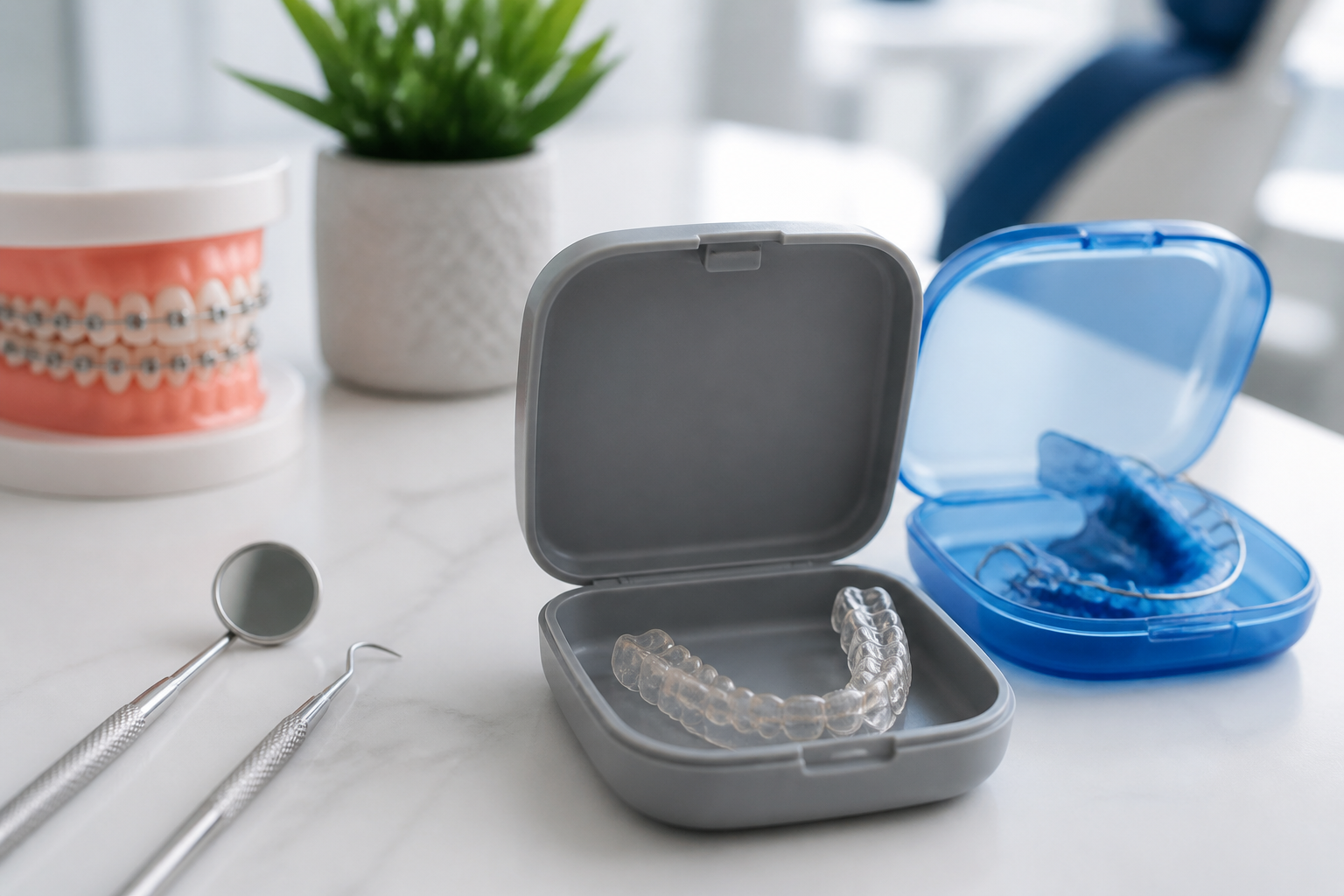
A fixed retainer is a thin wire bonded to the back surface of your front teeth, usually the lower six. You cannot see it from the front, you cannot remove it, and you do not have to remember to wear it. Because of those qualities, it is often recommended for patients with a higher relapse risk, particularly for the lower front teeth, which are among the most prone to shifting.
The tradeoff is maintenance. Flossing around a bonded wire takes practice and a floss threader or water flosser. If the wire breaks or lifts off a tooth, you need to have it repaired promptly, or the teeth near the break can shift before you notice.
Removable Retainers
Removable retainers come in two forms: a clear plastic tray (sometimes called an Essix retainer) that fits over your teeth like a thin mouthguard, or a Hawley retainer with a wire that runs across the front teeth anchored by an acrylic plate. Clear trays are the more common choice today because they are nearly invisible, comfortable, and easy to wear consistently.
The limitation of any removable retainer is that it only works when it is in your mouth. The most common reason for post-treatment relapse is not a flaw in the retainer design. It is patients forgetting to wear it, losing it, or gradually wearing it less and less until it stops fitting altogether. More on that in a moment.
For teens managing orthodontics for teens at SmileHaus, the team can help parents and patients figure out which system fits the household routine best, whether that is a fixed wire, a removable tray, or a combination of both.
What a Realistic Retainer Schedule Looks Like
Here is what most patients hear right after life with braces ends: wear your retainer full-time for the first several months, then transition to nights only. That guidance is accurate in broad strokes, but it is worth understanding the reasoning behind each phase.
Phase one (months one through six, roughly): The bone around your teeth is actively settling. Wearing the retainer as close to full-time as possible during this phase protects against the greatest relapse risk. You remove it to eat and brush, that is it.
Phase two (after the bone has matured): Nightly wear is typically sufficient to counteract the ligament pull that happens throughout the day. For most patients, nightly wear is a lifelong habit, not a temporary inconvenience.
Some adults find that even nightly wear becomes occasional over time, and that is where gradual shifting begins. A retainer that no longer fits comfortably is a signal that teeth have already moved. Trying to force it back in is not the answer. A visit to the practice at 1414 Fair Oaks Avenue, Unit 7 is.
The honest message: retention is not a phase with an end date. The patients who keep the straightest teeth long-term are the ones who simply never stop wearing their retainer at night. It becomes as automatic as brushing.
What Happens When You Skip the Retainer
Minor, gradual shifting is the most common outcome of inconsistent retainer wear. It tends to start with the lower front teeth, which have the strongest ligament memory and the least bone support. You might notice slight crowding or a tooth that seems to be rotating. Left unaddressed, that movement compounds over time.
In more significant cases, especially when a removable retainer has not been worn for months, the tray may no longer seat properly. Forcing it can put uneven pressure on teeth and is not recommended. At that point, the options depend on how much movement has occurred. Sometimes a new retainer can recapture a small amount of shift. Sometimes minor refinement treatment is needed.
This is a situation the team at SmileHaus Orthodontics sees regularly, so if you suspect your teeth have moved, the most helpful thing you can do is schedule an evaluation sooner rather than later. The longer you wait, the more involved the solution tends to be.
One useful habit for teens and adults alike: check every few months whether your retainer seats fully and comfortably. If it feels tight in a new way, or if a section does not fully contact your teeth, mention it at your next visit to 1414 Fair Oaks Avenue, Unit 7.
Retainer Care and Replacement
A retainer that is clean, intact, and well-fitting does its job quietly in the background. One that is cracked, warped, stained, or missing is a relapse risk.
Clear retainers should be rinsed every time you remove them and cleaned daily with a soft toothbrush and mild, non-abrasive soap or a retainer cleaning tablet. Avoid hot water, which can warp the plastic. Keep it in its case when it is not in your mouth. If a pet or a toddler gets hold of it, replace it.
Hawley retainers are more durable but should be brushed and soaked regularly. Bonded retainers require extra attention during flossing and should be checked by your orthodontist at regular intervals.
Clear retainers do wear out. Even with perfect care, most will need replacement every one to three years. If yours looks cloudy, feels rough, or has a visible crack, it is time for a new one. Replacement is straightforward at SmileHaus, and having a fresh retainer made is far easier than addressing relapse that built up while an old retainer sat in a drawer.
Making Retention a Habit That Sticks
The patients who succeed at long-term retention are not necessarily more disciplined. They just have better systems. A few approaches that work well in practice:
Anchor it to an existing habit. Put the retainer case next to your toothbrush. After brushing at night, the retainer goes in. No separate reminder needed.
Keep a backup. If you travel frequently or your retainer tends to go missing, ask the team at 1414 Fair Oaks Avenue, Unit 7 about having a second set made. The cost of a backup retainer is a fraction of the cost of relapse treatment.
Set a phone reminder for the first few weeks. Building any habit takes repetition. A simple nightly alarm labeled “retainer” removes the decision-making from a tired brain.
For parents of teens: Make the retainer part of the bedtime routine from day one. Teens who establish the habit early are far more likely to maintain it. If your child went through orthodontics for teens at SmileHaus, the team can walk through compliance strategies with both of you.
If you have questions about how braces work or what the full treatment process looks like from start to finish, the about braces overview covers the fundamentals clearly.
The Braces-Off Moment Is a Beginning
The day your braces come off is exciting, and it absolutely deserves to be celebrated. But the best way to protect that investment is to understand what comes next. Orthodontic retention is not a consolation prize at the end of treatment. It is the mechanism that keeps results stable over time — individual results vary, and long-term stability depends on consistent retainer wear.
Whether you are a recently treated adult, a teen whose braces just came off, or a parent trying to keep a teenager on track, the principles are the same: wear the retainer consistently, keep it clean, replace it when it wears out, and check in with your orthodontist if something feels different. The teeth you worked for are worth the habit.
If you have questions about retainers, want to explore your retention options, or need to have a retainer checked or replaced, the team at SmileHaus Orthodontics is ready to help. Schedule your free consultation today and let us help you give your results the best chance of lasting as long as possible.
SmileHaus Orthodontics is located at 1414 Fair Oaks Avenue, Unit 7. New patients are always welcome.