What “Wear Them 22 Hours a Day” Really Means, and How Families Make Aligner Compliance Work
You have probably heard the rule dozens of times before you even walked into an orthodontist’s office. Twenty-two hours a day. Out for meals, back in immediately after. Every day, for the full length of treatment. It sounds straightforward until you picture your teenager’s actual morning routine, or your own schedule of back-to-back lunch meetings and post-gym smoothies. Clear aligner compliance is the single factor that separates a treatment that finishes on time from one that drags on for months longer than planned, and most families don’t get a fully honest picture of what that discipline looks like in real life until they’re already in it.
This guide is for the parent who is genuinely excited about aligners for their teen but keeps running worst-case scenarios in their head, and for the adult patient who is self-aware enough to wonder whether their own habits are actually compatible with removable treatment. Both of those instincts are worth listening to.
What Actually Happens When Trays Are Under-Worn
The 22-hour guideline is not a conservative estimate padded for safety. It reflects the biology of tooth movement. Aligners work by applying consistent, gentle pressure to shift teeth incrementally. When trays are out, that pressure is absent. When they’re out too often, teeth begin to drift back toward their previous positions, working against the next tray in the sequence.
The practical consequence is tray fit. A tray that should feel snug on day one of a new two-week set can feel loose and uncomfortable if the previous set was under-worn. Loose trays apply uneven pressure, which means some teeth move less than planned. Over several trays, small gaps between planned and actual tooth position accumulate. The clinical term is “tracking failure,” and catching it early is far less disruptive than discovering it at the end of a planned treatment timeline.
For teens especially, the gap between reported and actual wear hours can be significant. It’s not always deliberate. Trays come out at lunch, the bell rings, and they stay in a pocket until dinner. Or they’re left on a cafeteria tray. The situations are ordinary and predictable, which is exactly why understanding them in advance matters.
The Numbers Behind the Rule
Two hours out per day sounds generous. In practice, those two hours disappear faster than most patients expect. Consider a typical day: breakfast takes 15 minutes, brushing and reinserting after takes another 5. Lunch runs 30 minutes. Dinner with a slow-moving family conversation stretches to 45 minutes. Add a mid-afternoon coffee and the post-dinner dessert a teenager grabbed from the kitchen, and you are already at nearly two hours before 8 p.m.
This isn’t meant to be alarming. It is meant to be accurate. Patients who understand where time goes are the ones who develop small habits that protect their wear time: keeping a travel toothbrush in every bag, setting a phone reminder to reinsert after meals, using a water bottle instead of snacking through the afternoon.
If you’d like a fuller picture of how the aligner process works from tray one to retention, the about aligners section on our site covers the mechanics in plain language.
Practical Strategies Families Actually Use
Families who report smooth aligner treatment experiences share several habits in common. None of them are heroic. They are small, repeatable routines that reduce the number of decisions required at weak moments.
Pair reinsertion with brushing. Every time trays come out for a meal, brushing before reinsertion becomes a natural stop. It protects teeth from trapping food under trays and makes putting them back in feel like the logical next step rather than an afterthought.
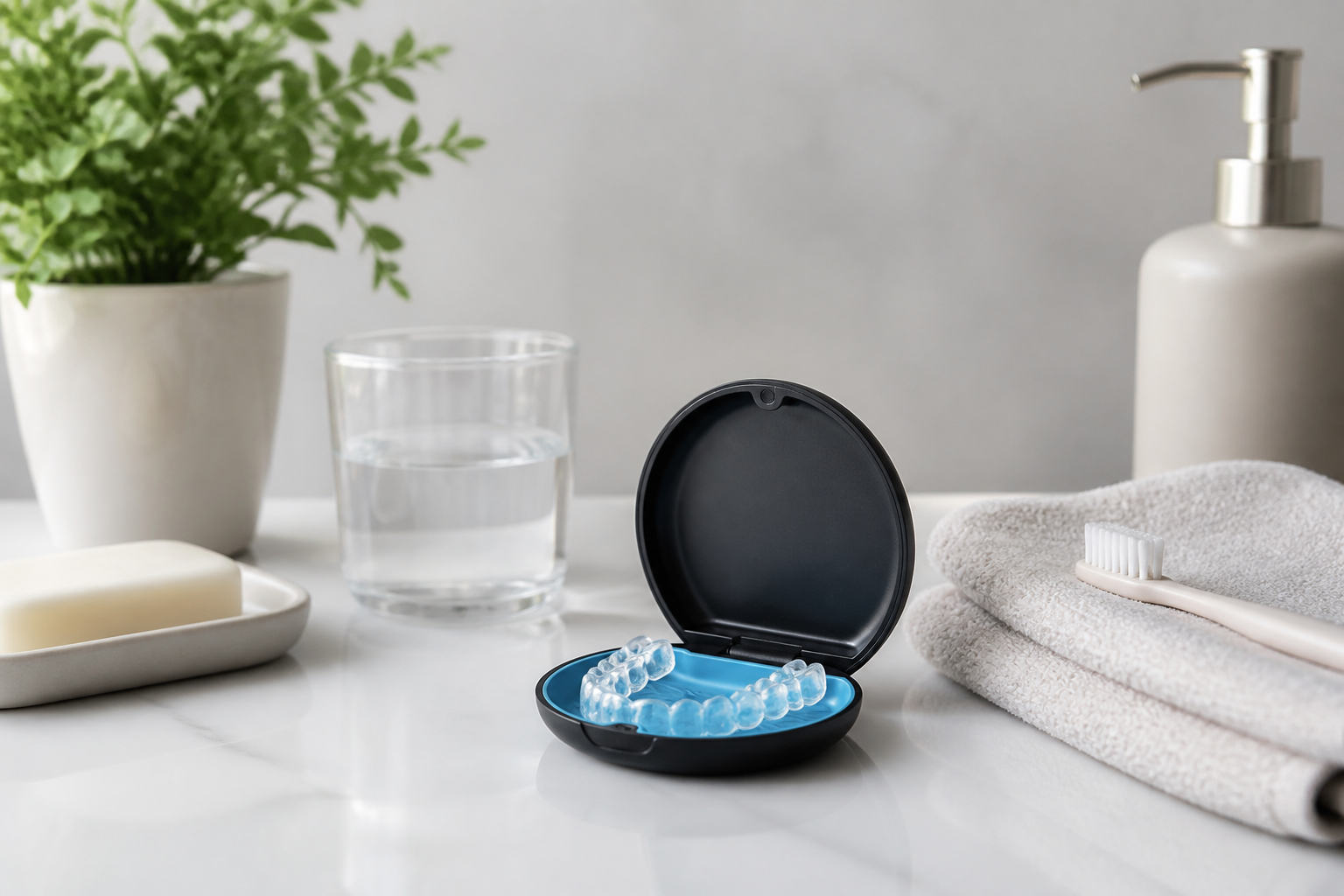
Keep a case everywhere. The leading cause of lost aligners is wrapping them in a napkin at a restaurant table. A case in every bag, every jacket pocket, and every school locker eliminates the most common accidental disposal scenario.
Use a tracking app or simple timer. Several free apps log daily wear time. For motivated teens, seeing a streak they don’t want to break can be genuinely effective. For others, a plain phone alarm labeled “TRAYS IN” set for 20 minutes after every meal works just as well.
Involve the patient in the goal. Teens who chose aligners themselves, rather than feeling like a choice was made for them, show better compliance across the board. When the outcome matters to them, reinsertion happens without a reminder.
At SmileHaus Orthodontics, the team serving families at 1414 Fair Oaks Avenue, Unit 7 talks through these habits at the start of every aligner case, with teenagers directly rather than only with their parents in the room.
How In-Person Oversight Catches Compliance Drift Early
One of the quieter advantages of working with an orthodontist rather than a mail-order aligner service is that in-person check-ins create structured opportunities to catch tracking problems before they compound. Dr. Thompson evaluates fit and tooth movement at each visit, not just at the end of a planned sequence. When a tray is not seating properly or teeth are not tracking as expected, the response can happen at that appointment rather than weeks later.
This matters more than it might initially seem. A single tracking issue caught at visit three requires a much smaller course correction than the same issue discovered at visit eight. Sometimes the adjustment is as simple as slowing the tray progression by extending the wear time on the current set. Other times, a few refinement trays are planned in advance as a buffer. In either case, the patient finishes treatment closer to the original timeline than they would have without that oversight.
For families coming to 1414 Fair Oaks Avenue, Unit 7, those check-ins are also a natural moment to have an honest conversation about wear habits. Dr. Thompson’s approach is matter-of-fact rather than judgmental. If wear time has slipped, the goal is to understand why and adjust the plan accordingly, not to lecture.
SmileHaus uses Spark clear aligners, a system from Ormco that is well regarded for its optical clarity and smooth edge comfort. When trays are comfortable to wear, patients wear them more consistently. It is a practical consideration that tends to get overlooked in comparisons focused only on aesthetics.
When Fixed Braces Are the More Straightforward Choice
An honest conversation about aligner compliance has to include this: for some patients, fixed braces are simply the lower-friction path to a great result.
This is not a concession or a consolation prize. Fixed braces, including the Pitts21 PRO braces system used at SmileHaus, work continuously without requiring daily discipline around removal and reinsertion. For a teenager who has a genuinely chaotic schedule, who participates in contact sports, or who has communicated clearly that the responsibility of removable treatment feels overwhelming, braces may deliver a better outcome in a shorter actual timeline than aligners worn inconsistently.
The same logic applies to some adults. If your job involves a lot of back-to-back client-facing time where reinsertion after meals is genuinely difficult to manage, or if your social life is structured in ways that make consistent wear hard to picture, that is worth saying out loud in a consultation rather than discovering six months in.
Braces and aligners are both excellent tools. The right tool depends on the case complexity, the patient’s preferences, and an honest assessment of the lifestyle factors that affect compliance. At 1414 Fair Oaks Avenue, Unit 7, that is exactly the kind of conversation Dr. Thompson is prepared to have with you.
What to Expect at Your Consultation
The consultation at SmileHaus Orthodontics is designed to surface these questions, not gloss over them. Dr. Thompson reviews case complexity, discusses the realistic discipline requirements of each treatment option, and gives families a clear picture of what success actually looks like for their specific situation.
For parents who are also thinking through the experience from a teenager’s perspective, the orthodontics for teens page covers what patients in that age group tend to care about most, from aesthetics to activity compatibility to how appointments are structured.
There are no wrong questions to bring to that first visit. If your leading concern is whether your teen will actually wear their aligners, say that. If you are an adult patient who is genuinely uncertain whether your lifestyle is compatible with removable treatment, say that too. Those are useful, specific starting points for a conversation that leads to a treatment plan you can actually follow through on.
The Bottom Line
Clear aligner compliance is real work. It is not difficult in the way that complex tasks are difficult, but it requires consistent attention every day for the full length of treatment, and that is a legitimate ask. Families and patients who go in with a clear-eyed understanding of that requirement, and who have practical habits in place from the start, tend to have smooth treatment experiences. Those who underestimate it often end up extending their timelines or switching to a different approach mid-treatment.
The goal of this guide is to make sure that does not happen to you. Know what the 22-hour rule actually means in the context of a real day. Build the small habits before they’re urgent. And have an honest conversation with an orthodontist who will give you straight answers about which treatment fits your life.
Contact SmileHaus Orthodontics today to schedule your free consultation and find out whether aligners, braces, or another path is the right fit for your specific goals and lifestyle. The team at 1414 Fair Oaks Avenue, Unit 7 is ready to walk through the options with you without pressure and without shortcuts.